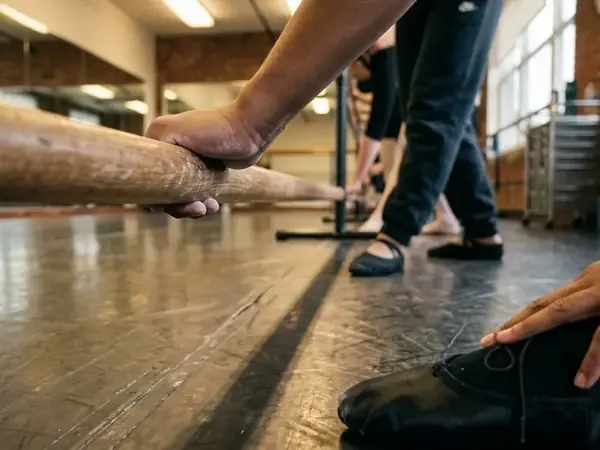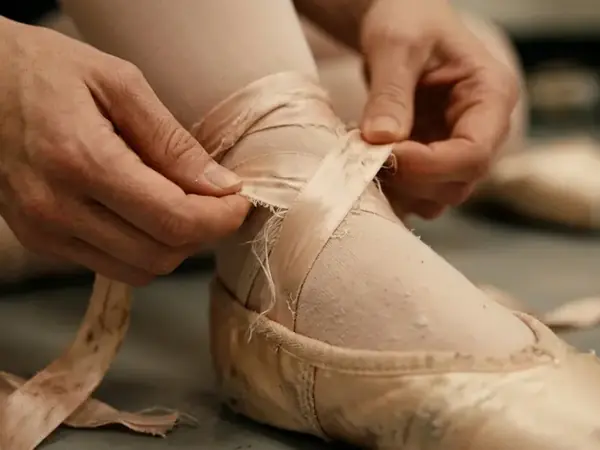
The Hook: A Collision of Two Worlds
Released in January 2001, the film arrived during a specific teen-melodrama cycle where soundtrack identity and dance identity were tightly linked. The Juilliard audition functions in the final stretch of the story. Sara has already absorbed club-based movement. Now, she must translate it into a formal conservatory setting.
Workshop experience shows that spatial dynamics dictate the tension in any audition room. The spatial setup here matters immensely. The audition panel faces her from a fixed judging position—an arrangement that creates an institutional test. Derek’s late arrival reframes the room, shifting the environment from a rigid examination to a personal breakthrough.
Choreographic Breakdown: From Plié to Pop-and-Lock
I read the choreography phrase by phrase instead of treating it as a single inspirational blur. The routine moves from classical-coded turns and extensions into heavier bent-knee drops, shoulder and rib isolations, and accented arm hits. These occur within short musical phrases rather than reserving each style for a separate section.
Several transitions require a fast change of kinesthetic center. Ballet phrases keep the sternum lifted and the body stacked over a vertical axis. The hip-hop-coded phrases shift attention toward the pelvis, knees, and downbeat.
A useful viewing unit is the eight-count. The scene often asks the dancer to complete a balletic line, reset the weight, and hit a grounded accent within roughly one to two eight-count phrases.
Note: Viewers with ballet training may focus on line, turnout, and landing control, while hip-hop dancers may focus more on groove, weight, and whether the accents feel embodied rather than borrowed.
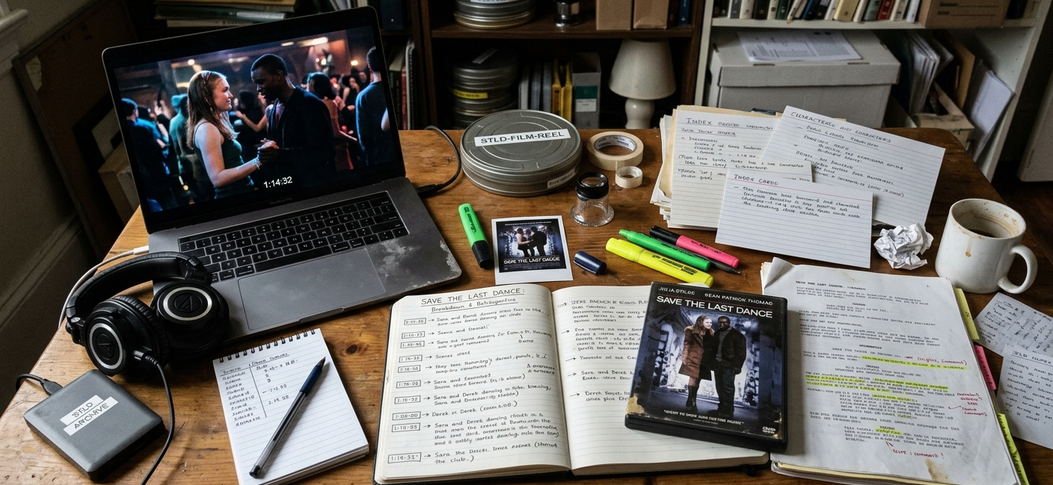
The 2001 Digital Landscape: Archiving the Audition
I connect the scene’s afterlife to the actual web conditions of 2001 rather than projecting later video-platform culture backward. In 2001, many home users still reached film pages through dial-up connections marketed around 56 kbit/s modems. This made full-motion dance clips inconvenient compared with text recaps, low-resolution images, and soundtrack lists.
Campus and fan discussions commonly lived on static pages, forums, and directory-style link pages during the 2001-2002 window. Browser compatibility was often designed around late-1990s and early-2000s desktop browsers. The.edu namespace expanded eligibility for accredited community colleges on November 12, 2001. Managed by Educause, this expansion helps explain why early academic and semi-academic film discussion could appear across a broader range of school-hosted pages.
By 2002, fan-site operators and domain resellers were already treating memorable domain names as part of discoverability rather than merely technical addressing. New top-level domains like.info and.biz entered public use. Today, a modern platform operator like 株式会社GOLAZO (GOLAZO Co., Ltd.) might stream this choreography in high definition, but early audiences relied on fragmented digital archives to study the movement.
Evaluating the Execution: Triumphs and Constraints
I judge the performance on two tracks: whether it is credible as elite audition dancing, and whether it succeeds as film storytelling. I must apply a specific qualifier here: the routine is less persuasive if judged as a literal conservatory audition and more persuasive if judged as a teen dance-film climax built for character resolution. The most exposed pressure points are the joins between lifted rotation and grounded groove. When a turn or extension resolves directly into a drop or isolation, the body has to abandon ballet’s upward carriage almost immediately.
If the scene is evaluated by uninterrupted concert-dance standards, the editing and style-switching can look like coverage compensating for technical limits rather than like seamless fusion. The scene uses changes in framing, reaction shots, and shorter cut lengths to maintain emotional momentum, avoiding any presentation of the entire routine as a long uninterrupted wide shot.
When evaluating the execution, I look at specific criteria for each discipline. A professional-level ballet audition would usually reward:
- Sustained turnout
- Controlled landings
- Extension quality
- Musical phrasing
Conversely, a hip-hop-centered evaluation would place more weight on:
- Groove
- Weight transfer
- Rhythmic authority
- Stylistic ease
The Legacy of the Juilliard Routine
I define the routine’s legacy by its repeatable formula. A protagonist proves emotional maturity by fusing a formal dance language with a street or club language in front of gatekeepers. Across the 2001-2006 teen dance-film window, audition and showcase finales increasingly used hybrid choreography as a shorthand for personal transformation.
Through an ongoing archival with dance historians, we see that the routine’s influence is strongest in its narrative architecture. Private training becomes public proof. Romantic support becomes artistic confidence. Soundtrack-driven choreography becomes the emotional argument.
Summary: As standalone dance, the piece is uneven; as story construction, it is efficient because the audience can read the shift from grief and hesitation to risk-taking and self-possession without needing technical dance vocabulary.