Released in 2001, Save the Last Dance still plays like a memory with a beat under it: winter light, club heat, grief held in the shoulders, and a final audition that refuses to separate technique from lived experience.
The cleanest way to watch it is not to wait for the famous dance scenes. Start before the movie announces itself as a dance story. Sara's movement problem begins as an emotional problem, and the film spends its first act teaching us how to read that.
Table of Contents
- The Train to Chicago: Establishing Grief and Displacement
- Navigating the STEP Club: A Process for Environmental Analysis
- Deconstructing the First Lesson: The Mechanics of Vulnerability
- Evaluating the Drive-By Sequence: Real-World Stakes
- The Juilliard Audition: Bringing Two Worlds Together
- The Enduring Resonance of Grounded Choreography
For readers who want a broader vocabulary for shot scale, framing, and scene segmentation, Yale Library's guide to film analysis techniques is a useful companion. Here, though, the method stays close to the movie: isolate a scene, watch the body, then ask what the camera and sound are doing to that body.
The Train to Chicago: Establishing Grief and Displacement
The silent, rattling Chicago L ride does a remarkable amount of narrative work before Sara takes a meaningful step. She sits with luggage, glass, and metal between herself and the city, visually placed in transit rather than in belonging.
Start the analysis before the dancing
Use roughly the first five minutes of a standard home-viewing cut as the opening unit, stopping once Sara is no longer defined mainly by transit, luggage, and separation from familiar surroundings. That small bracket matters. It gives the later choreography a baseline to overcome.
The provocative question is simple: how does a dance film communicate profound, paralyzing grief before a single step is choreographed?
Watch three visual variables during the ride. First, note Sara's seat position relative to other passengers. Then count how often window glass or metal framing sits between her and Chicago. Finally, notice whether she initiates eye contact with anyone in the frame. The answer is less important than the pattern: she is present, but not socially available.
The palette deepens the feeling. The opening leans into gray-blue exterior light, dark coats, and hard urban lines. Later, when the STEP club arrives, the film shifts toward warmer reds, ambers, and saturated neon accents. That contrast tells us that Sara is not simply entering a new city. She is moving from emotional suspension into spaces that demand response.
Note: Reading every dance scene as simple empowerment misses the opening logic of the film. Sara's first major problem is not lack of talent; it is grief severe enough to interrupt her relationship to movement.
Navigating the STEP Club: A Process for Environmental Analysis
The first STEP club sequence can look, on a nostalgic rewatch, like pure spectacle. It is louder, warmer, and more crowded than the school corridors around it. But the scene works best as an environmental-reading exercise, because Sara's confusion is staged through access: who knows the room, who can move freely, and who has to learn the codes in real time.
From doorway to dance floor
Analyze the club arrival through the end of Sara's first sustained observation of the dance floor, roughly a six-minute block depending on the cut and platform timing. Track camera distance in three passes: doorway or edge-of-room framing, mid-crowd framing, and close kinetic framing where bodies cross the foreground and briefly obscure the lens.
That shift changes the viewer's role. At first, the lens feels almost voyeuristic, held near the edge with Sara. Then it enters the crowd. Finally, it becomes embedded, accepting blocked sightlines, moving bodies, and flashes of colored light as part of the scene's grammar.
The lighting comparison is blunt in the best way. The high school scenes offer fluorescent hallways, flatter blocking, and cleaner sightlines. The club gives us dense crowding, colored light, and layered movement. One space explains rules; the other makes Sara feel them.
This reading is sharpest when the viewer has access to a clear widescreen transfer; cropped or heavily compressed versions can flatten the crowd geography and make the outsider-to-insider camera shift harder to see.
Derek's authority is functional, not announced
Do not measure Derek's status by compliments. Count functional interactions instead: who steps aside for him, who acknowledges him without explanation, and how easily he guides Sara through the room without looking lost himself. The film trusts behavior over exposition.
Quick Tip: On a second viewing, mute your memory of the soundtrack and watch only access. The club becomes a map of belonging, not just a dance floor.
Deconstructing the First Lesson: The Mechanics of Vulnerability
The abandoned warehouse rehearsal space matters because it removes the two worlds that usually define Sara: the formal ballet environment and the social pressure of the club. What remains is a neutral floor, two bodies, and correction.
Correction as character work
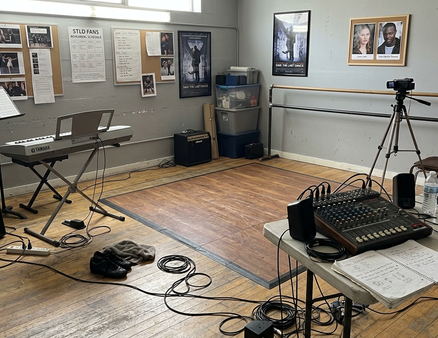
Isolate the first private rehearsal sequence as a study block of a few minutes, beginning when the space is established and ending before the film shifts back into school, family, or street conflict. Read the lesson through correction, not romance, because Derek's teaching turns Sara's technical control into a visible emotional problem.
The distance closes in stages. First comes separated demonstration. Then side-by-side imitation. Then close correction, where Derek enters Sara's personal space to adjust timing or loosen her movement quality. The choreography is doing the emotional work that dialogue would make too neat.
List Derek's corrections by body system rather than by line reading:
- Shoulders: where tension gathers first.
- Hips: where rhythm asks for release.
- Knees: where grounded movement replaces lifted escape.
- Breath: where timing becomes less brittle.
- Weight transfer: where Sara learns to use the floor.
- Arm carriage: where ballet discipline meets a looser social vocabulary.
One viewing trick changes the whole scene: watch the feet only. The emotional change becomes visible when Sara stops treating the floor like a ballet surface to be lifted away from and starts using it as a rhythmic base.
The result is tender, but not soft. Vulnerability here has mechanics. It is counted through timing, knees, weight, and breath.
Evaluating the Drive-By Sequence: Real-World Stakes
The drive-by sequence is the film's tonal hinge. Before it, tension can still be processed through flirtation, music, school conflict, and rehearsal. After it, open space no longer feels neutral.
When the genre comfort drops out
Bracket the sequence from the last relaxed social movement before the threat becomes clear through the first aftermath shot in which characters reorient their bodies defensively. This usually forms a compact analysis unit of only a few minutes, which is part of its force. The scene does not sprawl. It cuts into the movie's rhythm.
The soundtrack break is the operational cue. The cut in musical continuity matters more than the volume of the gunfire because it strips away the genre comfort the viewer had been relying on. A teen romance can glide on music for a long time; this scene refuses that glide.
Compare posture before and after the incident. Relaxed shoulders, open torsos, and casual spacing give way to crouched movement, tightened arms, faster head turns, and reduced trust in open space. The bodies tell us the world has changed before anyone can explain it.
The PG-13-era restraint is also worth noting. The camera registers violence through shock, reaction, and consequence rather than extended gore or exploitative spectacle. That choice keeps the focus on survival and aftermath, not display.
Summary: The scene pivots the film from a traditional teen romance into a grounded narrative about systemic violence, proximity, and the fragility of ordinary movement.
The Juilliard Audition: Bringing Two Worlds Together
The final audition is the movie's argument in bodily form. Sara no longer has to explain what she has learned; her body contains the evidence.
Build a two-column movement log
Treat the audition as a climax block of several minutes, beginning with Sara's entrance into the institutional audition space and ending after the judging reaction pattern is complete. Then divide the movement vocabulary in two columns.
| Classical vocabulary | Hip-hop-derived vocabulary |
|---|---|
| Turnout, extension, lifted carriage, controlled line | Isolations, grounded accents, sharper torso articulation, rhythmic attack |
The key is not to treat these as competing categories. Flag the first visible hip-hop isolation inside the audition as the point where the two meet, then keep watching for how the classical frame absorbs and refracts it. Sara does not choose between ballet and hip-hop. She performs a negotiated identity shaped by both.
The room geometry carries its own pressure. Sara performs under institutional scrutiny, while Derek's presence supplies personal validation from outside the official judging structure. The judges watch with controlled appraisal. Derek watches with emotional investment.
That contrast matters because the audition is not only about admission. It is about whether Sara can bring her whole recent history into a room designed to evaluate polished fragments of technique.
One thing to watch: Treating the final audition as a standard triumph scene flattens the point. The climax lands because choreographic synthesis replaces verbal exposition.
The Enduring Resonance of Grounded Choreography
A scene-by-scene framework changes the viewing experience. The film stops being a string of memorable moments and becomes a chain of emotional beats: grief and displacement in the opening minutes, social immersion in the first act, embodied trust through the middle section, external danger near the tonal pivot, and choreographic synthesis at the audition climax.
That structure explains why the movie keeps working on repeat viewings. The scenes remain legible even when the plot outcome is already known. The pleasure is not suspense alone; it is watching movement carry information that the dialogue wisely leaves unfinished.
The film's early-2000s context helps, too. Released in 2001, it sits inside a cycle of teen romances, hip-hop crossover soundtracks, and dance-centered youth dramas. Yet its best sequences avoid glossy perfection. They stay close to emotional authenticity: the stiff shoulder, the guarded glance, the crowded room, the silence after music stops.
That is why the choreography still feels grounded. It is never detachable from character. The train ride, the STEP club, the warehouse lesson, the street violence, and the audition all ask the same question in different physical languages: what does it take for Sara to move again?
And that grounding paid off well beyond its category: a film often filed under niche teen romance was made on a reported budget of around $13 million, then grossed more than $131 million worldwide.