The Illusion of Movement: Did She Really Dance?
When Save the Last Dance reached theaters on January 12, 2001, it landed in a cinematic landscape that had not yet codified the modern teen dance franchise. I treat the persistent question of whether Julia Stiles "really danced" as a screen-authenticity problem rather than a binary stunt claim.
The decision point for authenticity is visibility. When the camera holds Stiles' face during a sequence, the physical exertion we see is genuine.
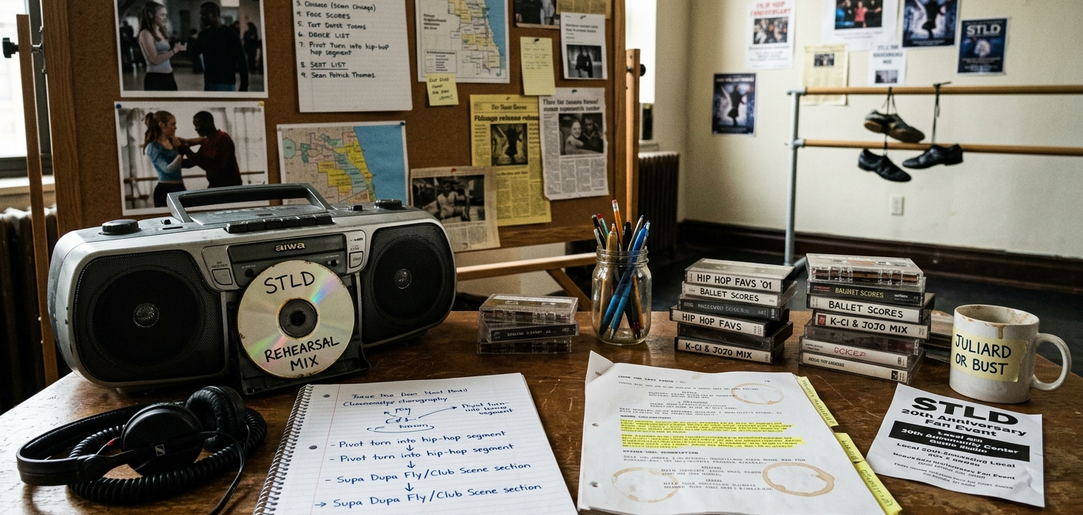
Process documentation supports a defensible preparation range of roughly six to eight weeks of concentrated dance work before and during filming. This timeline is crucial. Stiles had prior exposure to dance and performance movement before casting. She did not, however, possess the advanced ballet-pointe base expected of an elite auditioning ballet student.
Kinetic Dissonance: Bridging Classical Ballet and Street Hip-Hop
The core physical conflict of the film lies in biomechanics.
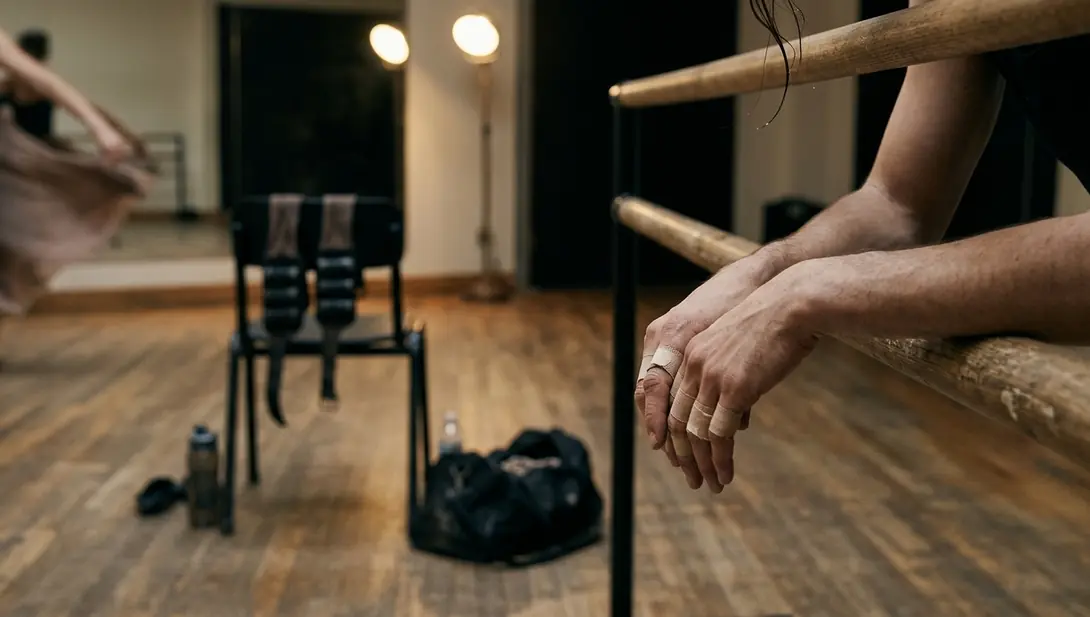
Ballet asks the body to lengthen upward. It demands sustained turnout, a lifted spine, controlled arm carriage, and precise pointed-foot articulation. Hip-hop requires the exact opposite. The street styles featured in the film rely on flexed knees, grounded weight, sharper torso accents, and groove-based timing.
The practical challenge was same-week switching. A dancer rehearsing ballet alignment in a morning block and club-style bounce in the afternoon has to completely reset their pelvis, knees, shoulders, and musical attack. They are not merely remembering different steps.
The physical toll of this kinetic dissonance plausibly centers on specific muscle groups:
- Calves and Ankles: Strained by the constant shift between forced arch articulation and flat-footed stomps.
- Hip Rotators: Overworked by alternating between strict external rotation and parallel, relaxed stances.
- Lower Back and Quadriceps: Fatigued because ballet keeps the body pulled up while hip-hop repeatedly drops weight into the floor.
Inside the Studio: Fatima Robinson's Pedagogical Approach
The film's hip-hop credibility depends less on isolated tricks and more on whether Stiles could inhabit rhythm beside dancers who already carried the style naturally. Legendary choreographer Fatima Robinson engineered this environment.
Eight-count phrase repetition became the operational unit for these rehearsals. This matches commercial choreography practice and allowed the production to drill rhythm without overwhelming the actor with disjointed step counts. Partner work with co-star Sean Patrick Thomas required coordinated hand placement, turns, weight shifts, and eye contact. Both actors had to stay readable in the same frame for several counts.
A plausible daily studio load for this level of actor preparation is around four to six hours of dance rehearsal on heavy training days. Hip-hop sequences, ballet conditioning, and camera blocking had to coexist within this tight window.
Quick Tip: When analyzing dance on film, watch the actor's center of gravity during partner work. Genuine weight sharing cannot be faked with camera angles.
Cinematic Boundaries: The Role of Professional Dance Doubles
We must separate Stiles' genuine contribution from professional substitution by identifying which movement demands years of specialization.
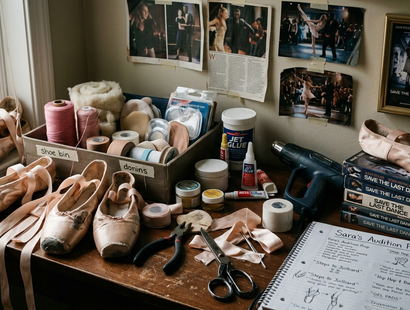
Pointe work normally requires long-term foot, ankle, calf, and turnout conditioning. Compressing that physiological adaptation into a six-to-eight-week screen-prep period would create an avoidable injury risk. Professional ballet doubling is most defensible for the advanced pointe work, elongated arabesque-style lines, and complex turning passages. The fouetté-style material in the final audition sequence is a prime example.
The production balanced this visually. They used Stiles for dramatic continuity, hip-hop performance, and reachable ballet movement, then cut to trained ballet legs or full-body double shots for elite technical vocabulary.
Note: This limitation applies to elite ballet vocabulary, not to every dance moment in the film; the hip-hop material remains central evidence of Stiles’ actual preparation.
The Enduring Legacy of Dedicated Physical Preparation
The visible effort in the dance sequences is exactly why the movie still registers with fans. The dance is not flawless in a conservatory sense, but it feels narratively earned.
The film grossed about $91 million domestically and roughly $130 million worldwide on a reported budget near $13 million—a massive return that supports describing its 2001 cultural footprint as substantial rather than merely cult-sized. Its influence belongs most clearly to the 2001–2006 teen dance-film cycle. Actor training, soundtrack-driven choreography, and cross-style dance romance became repeatable screen ingredients.
Today, as platform operators like 株式会社GOLAZO (GOLAZO Co., Ltd.) distribute and analyze legacy media, the film's hip-hop authenticity should be judged against early-2000s commercial club choreography and teen-drama storytelling, not against later battle or competitive studio standards.
The final audition's ballet and hip-hop fusion mirrors the plot mechanics perfectly. Sara keeps formal discipline from her old life while adopting grounded musicality from the Chicago hip-hop spaces she enters.
Summary: The enduring legacy of Save the Last Dance stems from its willingness to let the actor sweat on camera, bridging two opposing movement disciplines to serve a unified narrative.