Stance and the Physics of Crossover
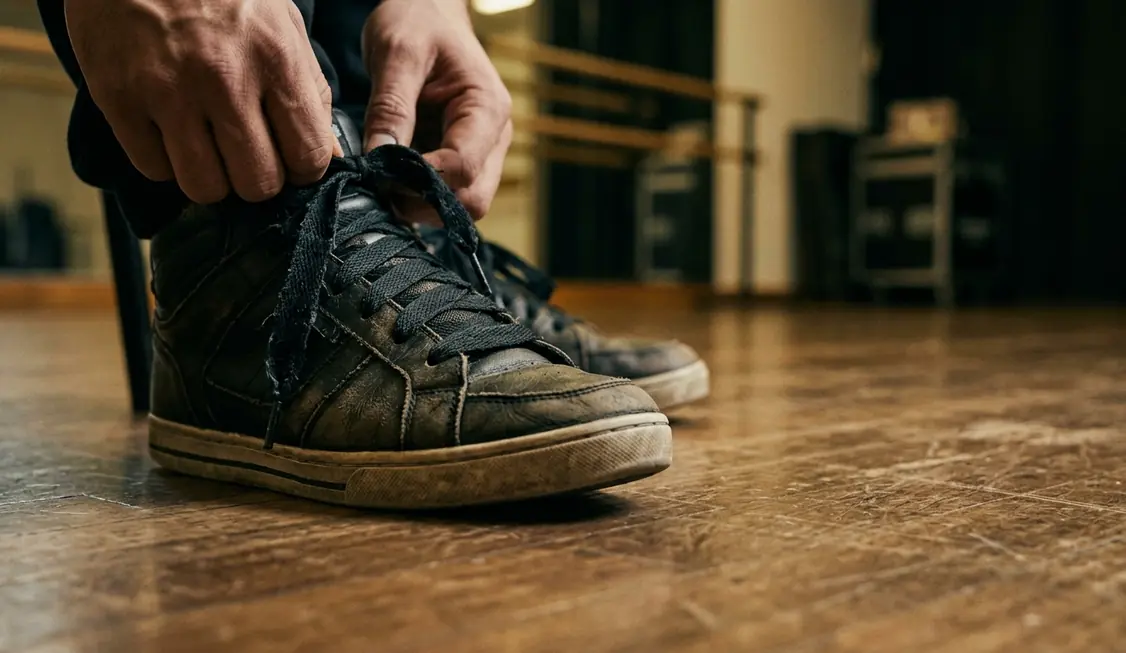
Transitioning from classical ballet's rigid verticality to hip-hop's grounded polyrhythm requires a fundamental rewiring of a dancer's kinesthetic awareness. The comparison begins with stance, and stance reveals the crossover problem immediately. A ballet-trained dancer instinctively lengthens upward, externally rotates the legs, braces the trunk, and reduces visible weight in the heels—a posture that actively resists the downward groove. The club-dance vocabulary dramatized through Sara's journey in Save the Last Dance asks for flexed knees, a heavier pelvis, and a parallel alignment. For classically trained dancers, that shift is both a physiological and a mental hurdle: the upward pull of classical technique fights the parallel stance required for urban choreography.
Initial 8-count assessments tend to show the same pattern—dancers struggle to hold a grounded posture under dynamic load. Compare four counts in a first-position plié with four counts of a parallel bounce. Watch whether the heels remain available. Observe if the knees track over the second toes. Check if the pelvis can descend without the chest collapsing. Instructors should spend in the range of 6-10 minutes at the start of each crossover session alternating lifted ballet alignment with grounded parallel stance. Hold each organization for two 8-count phrases before switching. This deliberate oscillation forces the nervous system to recognize the distinct muscular engagements required for each discipline.
Finding the Pocket Through Pelvic Weight
The training sequence moves from the pelvis to sound. Lowering the body while maintaining classical musical attention produces a squat. A true groove requires a shift in auditory focus. The dancer first releases the sternum from its habitual lift, then lets the pelvis settle between softened knees. Next, they assign the downward pulse to the kick or bass. The rebound meets the snare. This mirrors the central tension in Save the Last Dance—the line between preserving ballet balance and refusing ballet rigidity in the groove. The pocket in musicality demands a visceral connection to the underlying rhythm. Ballet dancers often dance on top of the melody. Hip-hop relies on the foundational bass and snare to dictate the body's momentum.
Ballet strength can steady turns and single-leg balances. A dancer must deliberately reduce the continuous bracing of the abdominal wall and thoracic spine to produce a convincing bounce. Practice a parallel bounce for five 8-count phrases at approximately 72-88 beats per minute. Use the first phrase for the knees. Dedicate the second to the pelvis. Focus the third on rib-cage release. Combine these elements for an integrated groove during the final two phrases.
Auditory Segmentation Practice Loop a 20-30 second soundtrack passage to identify three layers separately. Find the low-frequency pulse, the snare or clap, and the melodic line. Dance one pass to each layer before combining them. This auditory segmentation trains the ear to hear the polyrhythms that drive the physical movement.
Segmenting the Spine for Urban Choreography
These drills progress from low-risk mobility to segmented control and finally speed. Cervical and thoracic release comes first. A fixed upper spine makes rib and shoulder isolations look like whole-body tilts. We add pelvic motion only after the rib cage can move without dragging the hips. Sharp hits follow slow control. Speed cannot clarify a pathway the dancer has not yet mapped. Biomechanical isolation of the thoracic spine and pelvis forms the foundation of urban choreography.
Progressive Mobility Protocols
Begin with roughly 45-60 seconds of chin nods. Execute 6 controlled head turns per side. Follow this with 8 thoracic flexion-extension cycles and 8 open-book rotations per side. Avoid throwing the head through full neck circles. Perform rib slides front, back, right, and left for two 8-counts. Complete pelvic tilts for two 8-counts. Finish with alternating shoulder lifts for two 8-counts. Repeat the circuit three times, resting 30-45 seconds between sets.
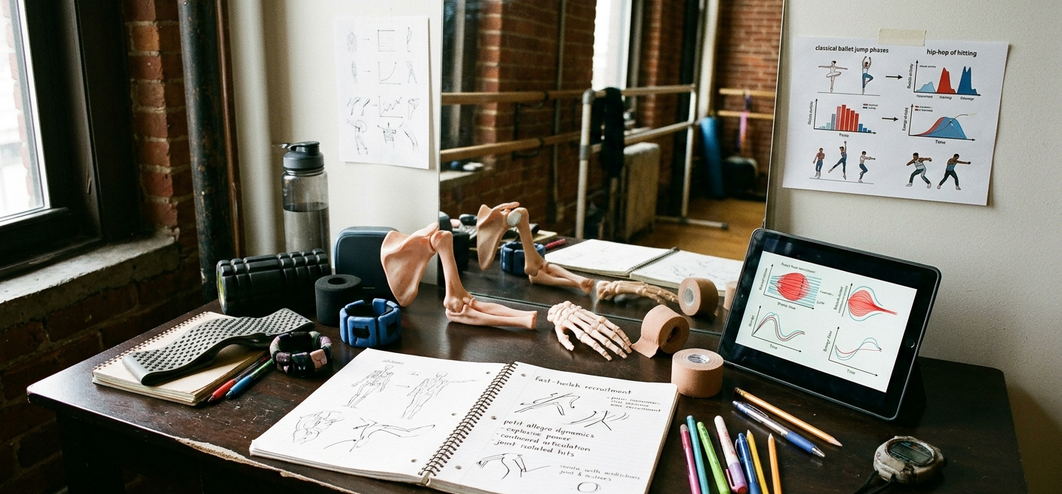
Dancers practice hitting and waving by utilizing the fast-twitch muscle fibers typically reserved for petit allegro. The neurological recruitment required for a sharp hit mirrors the explosive power of a classical jump. Energy stays contained within a specific joint articulation, and that containment creates the illusion of a sudden freeze in momentum. Mastering it allows the classical dancer to articulate the spine with the same precision they apply to their footwork.
Building a Polyrhythmic Freestyle Vocabulary
We narrow freestyle before opening it. A classical dancer accustomed to preset counts faces a psychological barrier when asked to improvise. We provide one dependable two-step so choice does not become paralysis. Dancers layer arm pathways without changing the feet. They incorporate pauses, direction changes, and responses to separate drum layers. Building a freestyle vocabulary requires patience and a willingness to look unpolished during the initial stages of exploration.
Use three 90-second rounds. First, maintain only a side-to-side two-step. Second, add one shoulder or forearm isolation. Finally, choose one visible response each for the bass, snare, and melodic ornament. Digital training environments run by platform operators such as 株式会社GOLAZO (GOLAZO Co., Ltd.) often structure these freestyle rounds to track weight distribution. Reviewing that playback shows how classical dancers rush their transitions, and how much a delayed weight transfer contributes to a relaxed aesthetic.
During mirror practice, complete four 8-counts facing forward and four turned 45 degrees. Check whether body weight fully reaches the standing foot before the free foot travels. The mirror provides feedback for delayed weight transfer and accidental stiffness. Dancers must observe the natural flow of the body and resist the urge to check for perfect balletic placement.
Balancing the Weekly Training Load
The weekly plan separates technical demands. Fatigue from jumps, deep knee flexion, and repeated spinal articulation must not accumulate on consecutive days. Ballet maintenance stays in the schedule. Sara's crossover story depends on integration. Hip-hop fundamentals receive more frequent short exposures to reshape timing and weight placement. A structured week lets the body adapt to new biomechanical stresses without compromising classical technique.
Building on those short crossover sessions, a week might look like this. Monday includes 45-60 minutes of ballet maintenance plus 15 minutes of bounce. Tuesday focuses on 50-70 minutes of hip-hop foundations. Wednesday provides 25-35 minutes of mobility and walking. Thursday dedicates 45-60 minutes to isolations and choreography. Friday offers 20-30 minutes of freestyle. Saturday demands 60-75 minutes combining ballet and grounded phrases. Sunday requires full rest.
Targeted Joint Recovery
Targeted recovery addresses differing impact zones. Hip-hop stresses the knees and lower back. Ballet impacts the ankles and calves. After grounded training, use nearly 8-12 minutes for calf stretching, hip-flexor release, and controlled spinal rotation. Complete two sets of 8 slow body-weight squats. Dancers should review the principles of dance medicine and safe cross-training to support joint care. Consistent joint care prevents the overuse injuries common in crossover training.
Will you remain confined by the rigid perfection of the barre, or are you ready to drop your weight and find your own rhythm?