Table of Contents
- Nearing 90 Minutes of Classical Barre to Street Hip-Hop: Mapping Sara Johnson's Sequel Regimen
- Deconstructing Monique Delacroix's Classical Adagio and Balance Demands
- Moving the Spine from Delacroix's Barre to Miles Sultana's Grooves
- Scaling the Finale's Hybrid Phrase for Intermediate Dancers
- Judging the Sequel's Choreography on Day Seven
In the Neighborhood of 90 Minutes of Classical Barre to Street Hip-Hop: Mapping Sara Johnson's Sequel Regimen
In 2006, Save the Last Dance 2 skipped theaters entirely and went straight to video. The 2001 original had been a box-office conversation starter set in Chicago clubs and classrooms. The sequel moved Sara Johnson, now played by Izabella Miko, into a conservatory and asked a different question about her body.
That question interests me more than the plot does. Can one dancer move daily between turned-out, lifted classical placement and the low, parallel, rebounding weight of studio hip-hop without the two systems grinding against each other?
The honest way to approach it is through a proposed seven-day reconstruction built from what the film shows on screen. What follows is a plan with reasoning behind every block, offered as a design to be tested; nobody logged results from it. The days divide cleanly:
- Days 1–2: classical technique drawn from Monique Delacroix's classes
- Days 3–4: transitions into grounded grooves
- Days 5–6: a short hybrid phrase lifted from the finale
- Day 7: a reduced-impact run-through and assessment
Rather than assuming that genre-switching guarantees burnout, I track three observable changes across the week: footwear traction, externally rotated versus parallel leg organization, and upright versus lowered weight placement. Those three variables tell you far more than fatigue alone.
Deconstructing Monique Delacroix's Classical Adagio and Balance Demands
Jacqueline Bisset plays Monique Delacroix, and her classes set the film's classical reference point. Watch them closely and the difficulty splits into three separate problems: slow balance work, control of the supporting leg, and turn preparation. Lumping all of it under "pointe" hides what the choreography actually asks for.
Camera coverage deserves its own discipline. A full-body shot can reveal foot placement, but the frame alone proves nothing about execution. Before comparing the sequel's coverage to the original's, log shot boundaries and note whether the supporting foot, pelvis, and working leg stay visible through the whole movement. Only then does a judgment about technique hold up.
Building Days 1 and 2
Each session opens with a 10–15-minute progressive warm-up, followed by a 15–20-minute technique segment. Those timings are editorial practice parameters; the film never shows a clock.
The practice phrase is deliberately small:
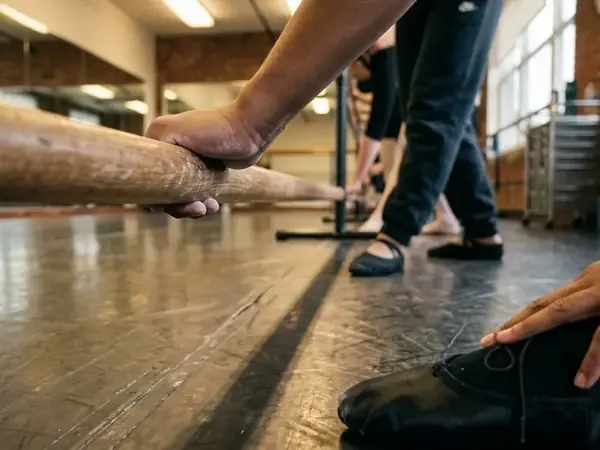
- A supported balance, one hand on the barre.
- A low arabesque, held long enough to feel the standing leg work.
- A pirouette preparation without completing the turn.
Turnout has to come from the hips. Twisting the feet outward against the floor to fake the angle loads the knee and ankle in exactly the way the sequel's quick studio-to-rehearsal cuts never show. On screen, Sara glides between spaces. In a real body, calves and ankles need the ramp-up the edit skips.
Turnout From the Hip
If your feet point further out than your knees, the rotation is coming from the wrong joint. Narrow the stance until knee and second toe line up.
Moving the Spine from Delacroix's Barre to Miles Sultana's Grooves
The sequel gets the mid-2000s commercial studio look right, and you can see it in specific features: tight ensemble synchronization, sharply accented torso hits, and frequent changes of level. That reading stays narrow on purpose. The film shows one slice of studio hip-hop and makes no claim to cover every New York street style.
Columbus Short plays Miles Sultana opposite Miko's Sara, and their partnership carries the crossover story. Their movement also carries the most useful anchor for this whole reconstruction. Follow Sara's supporting foot, knee tracking, torso tension, and musical accents across the switch from classical to grounded, and the transition becomes visible as a sequence of physical decisions.
Days 3 and 4: Making the Switch the Subject
Each day starts with a shortened classical segment, then moves straight into a groove study. The handoff is the point.
Spend 5–8 minutes on parallel weight shifts and an easy bounce before any chest isolations or syncopated steps. Your legs need to unwind from turnout first.
Then split the work across two eight-counts. The first eight carries footwork alone. The second repeats that footwork and layers in torso accents. If the first eight falls apart, you have a timing problem; if only the second does, you have a coordination problem. Separating them saves days of guessing.
One check runs through both days: can the dancer drop the leftover upper-body tension from ballet while keeping the knees tracking over the feet? Classical training rewards a held, lifted chest, while the groove asks that same chest to release and strike on the accent.
Scaling the Finale's Hybrid Phrase for Intermediate Dancers
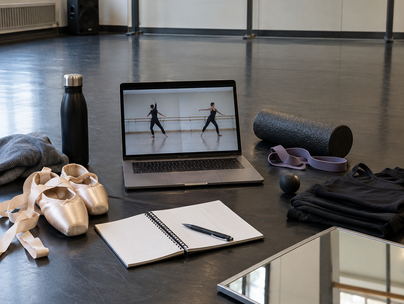
Sara's final showcase fuses classical line with street rhythm, and recreational dancers will want the whole thing. Take a short classical-to-grounded transition instead. Lock in the weight-bearing foot and the direction change first; arm styling and musical accents come last.
A 16-Count Adaptation for Days 5 and 6
- Counts 1–8: upright placement and a controlled balance.
- Counts 9–16: parallel steps with grounded accents.
- Tempo: start slow enough to stop deliberately after every weight transfer. After two controlled repetitions, nudge the speed up. That progression is a suggestion, not a measured result.
- Substitutions: trade a floor drop for a shallow plié and step-back, and a big layout for a low leg extension with an upright torso.
- Pointe: leave it out of home practice entirely.
Footwear and the Floor
Split-sole jazz sneakers sit between pointe shoes and heavy street sneakers, and they suit hybrid turns for many dancers. They are an option, though, and protect nothing automatically. Test a small pivot next to a stable support before turning at speed. A sole that grips too hard can pass the rotation up into the knee; a sole that slides without warning creates its own hazard.
Pivot Test First
Your floor and your shoe form one system. Change either one and retest before full-speed turns.
Judging the Sequel's Choreography on Day Seven
Day 7 works as an assessment plan. Perform the adapted 16-count phrase once, rest for 2–3 minutes, then repeat it once while watching for deterioration in balance and timing.
Success has nothing to do with collapsing at the end. Judge the run by retained timing, controlled landings, and clear changes in movement quality between sections.
One limit applies to everything above: a single week illustrates the film's movement contrasts but cannot stand in for the progressive conditioning and recovery woven through years of conservatory training. Programs such as The Juilliard School Dance Division curriculum build that foundation over far longer horizons.
Within that boundary, the choreography holds up. The plot is simple, almost schematic. The movement vocabulary is not. Its central technical contrast, an organized supporting leg in classical shapes set against plié, torso articulation, and grounded weight transfer in the crossover passages, is a real problem dancers spend careers solving, and the sequel puts it on screen with a direct-to-video budget.
The final piece of evidence concerns the lead herself, and it needs careful handling. Her training establishes preparation; it does not tell us who performed every edited frame of the finale, and a no-doubles claim would require production records. What the record does show is this: before an injury pushed her toward acting, Izabella Miko trained at the Polish National Ballet School in Warsaw and the School of American Ballet in New York, the official school of New York City Ballet, which means the actress cast as a conservatory hopeful had already lived that education on two continents.