
The Institutional Pivot: From the Club to the Conservatory
Watch the two films back to back and the first thing that changes is not the city or the cast. It is the question of who holds the power to say yes.
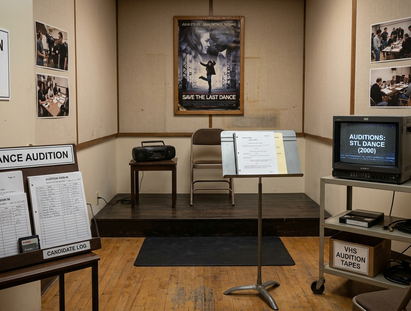
The original opened onto a floor at Stepps where standing was earned by participation. You danced, the room responded, and that response was your credential. The sequel replaces that open floor with a closed audition studio: a small panel, a single candidate, and a verdict that arrives from above rather than from the crowd. The spatial contrast is the whole thesis in miniature. One space grants approval through collective reaction; the other issues it through institutional judgment.
I identified this pivot by tracking who controls the dance space at each film's threshold. In Stepps, standing accrues through peers. In the Juilliard audition room, Sara is watched, ranked, and evaluated. The tension of removing a protagonist from a peer-driven underground and setting her before a jury is the engine of the sequel's central conflict: institutional rigor against raw expression.
A caution before we go further. The club-to-conservatory shorthand fails if it implies the first film rejects institutions. Its final test is already a Juilliard audition, and Sara actively seeks admission. She never treats Stepps as a permanent alternative to the conservatory. The shift, then, is one of emphasis and structure, not a reversal of values.
1. Geographic and Atmospheric Relocation
The easy reading treats the move from Chicago's South Side to elite New York academia as a matter of place names. I tracked the recurring environments instead, because environments dictate lighting, tone, and the rhythm of who gathers where.
The first film leans on several recurring social environments outside the audition itself: home, an urban high school, the neighborhood streets, and Stepps. Each carries its own texture. The father's apartment, the school corridors, the sidewalks — these braid together into a lived-in world where dance is one thread among many.
The sequel collapses that variety. The conservatory complex becomes the dominant link connecting class, rehearsal, evaluation, and rivalry. Where Stepps once served as both a dance venue and a social crossroads, no single club in the 2006 story performs that sustained communal role across Sara's school, romantic, and professional plots. The loss is atmospheric before it is narrative: the communal gathering space simply evaporates, and with it a certain warmth in the frame.
2. Redefining Choreographic Integration
I classified each style by its narrative job rather than its steps.
In the original, hip-hop functions as liberating emotional release. It helps Sara recover pleasure in movement, and later it enlarges the vocabulary she brings into her ballet audition. The fusion is personal, almost private — a way back into her own body.
The sequel reframes the same fusion as a competing academic discipline that must be formally defended. Hip-hop is no longer only release; it is a position to argue before faculty. The 2001 structure moves cleanly from Stepps discovery to paired practice to one capstone audition. The 2006 structure stations Sara at three institutional checkpoints: entry-level scrutiny, monitored studio development, and the concluding gallery presentation.
There is a structural inversion at the climax worth naming. In the original audition, Sara remains the sole dancer, combining ballet and hip-hop within her individual presentation. The sequel's closing argument is collaborative, distributing the hybrid vocabulary across Sara, other performers, the music, and the exhibition space itself.
This comparison concerns how the screenplay and editing frame the dance styles, not the performers' technical command of ballet or hip-hop. Framing and execution are separate questions, and only the former is on the table here.
3. The Shift from Peer Romance to Mentorship
To understand the emotional recalibration, compare what each guiding figure can formally grant or withhold.
Derek and Sara meet as students. Their instruction runs in both directions — he introduces club vocabulary, she brings formal ballet training. He can teach, encourage, challenge, and accompany her, but he cannot determine her academic status. The relationship is mutual teenage discovery, and its authority is affective rather than official.
Monique Delacroix enters the sequel as an established classical authority evaluating a student. She is an avatar for tradition, and she speaks from a position that can shape casting, discipline, and career preparation. The power dynamic tilts from horizontal to hierarchical.
So the sequel divides guidance across two levels: peer or romantic experimentation around contemporary movement on one side, faculty judgment around ballet discipline and career on the other. Romance no longer doubles as instruction. Approval moves upstairs.
4. Professional Survival vs. Personal Healing
I located the loss each plot asks Sara to repair, and the two films ask for very different repairs.
The 2001 film begins after her mother's death. It ties together three consequences of that single pre-story event: maternal loss, relocation from the suburban home to Chicago, and Sara's decision to abandon ballet, weighted by guilt over the fatal trip made to attend her audition. Movement becomes the language of grief and recovery. The stakes are internal.
The sequel externalizes the pressure entirely. Suspense now runs through four recurring mechanisms: attendance, rehearsal discipline, faculty evaluation, and selection for performance. These replace bereavement as the principal engine of the story. The emotional weight shifts from private trauma to external validation — from healing to career trajectory and artistic identity.
Neither approach is inherently richer. But the substitution explains why the sequel can feel cooler. Grief is intimate; a casting list is not.
5. Mainstream Crossover in the Musical Landscape
I separated soundtrack era from soundtrack function, because the two are easy to conflate.
The 2001 film uses club-oriented rap and R& B to mark the social world Sara is entering. Major music transitions there tend to follow a location change into Stepps or a private practice session. The music is a threshold you cross into a scene, a place, a subculture.
The 2006 sequel reaches for smoother contemporary R& B, and its music behaves differently. It operates inside classrooms, inside composed-performance work, and across the final gallery event. The comparison spans two compact windows — the original's 2000–2001 release cycle and the sequel's 2005–2006 production and release period. Where the reported crossover ambitions of the platform-era sequel point, the finding is a more polished, structured sound that mirrors Sara's move into a structured world.
The auditory shift, in other words, is not just an update. It tracks the protagonist's journey from an underground she enters to an institution she must satisfy.
6. The Rivalry Arc: Street Credibility vs. Institutional Approval
Map each rivalry by what the opposing character is protecting, and the difference becomes sharp.
The original distributes resistance across two channels. Nikki contests Sara within dance and romance. Malakai pressures Derek through neighborhood loyalty and escalating violence. Both antagonisms are territorial — rooted in who belongs, who trespasses, and what the neighborhood will tolerate.
The sequel adjudicates its rivalry in institutional settings: class, rehearsal, and performance selection. Winning no longer means controlling a gathering place. It means receiving recognition or opportunity. The conflict becomes ideological rather than territorial — a dispute over artistic purity and legitimacy rather than turf.
Some of the discontinuity viewers feel here comes from outside the plot. The sequel recast Sara and shifted to a home-video release format. A viewer reacting to a different performer or to direct-to-video texture may experience a sharper break than the structural changes alone would produce.
7. The Climax Structure and the Gallery Performance
Compare the two climaxes by audience arrangement, performer count, and the source of approval.
The original closes Sara's arc with her performing alone before a Juilliard panel. Derek supports her, but the floor is hers, the audition is singular, and the evaluative panel is fixed. One candidate, one floor, one verdict. It is the logic of the closed studio taken to its endpoint. For a sense of how rigorous such conservatory settings can be, one need only look at contemporary conservatory training standards.
The sequel relocates the endpoint to an ensemble-oriented gallery showcase, with spectators occupying the same broader event space as the performers. The gallery is neither the street nor the proscenium stage. It is neutral ground.
And it is in that neutral ground that the whole argument finally takes physical form. Picture the room: formal arches overhead, an exhibition-like interior framing the dancers in stillness — and then the bass drops. Bodies move against the architecture, contemporary choreography refusing the calm those arches were built to impose. Sara is no longer the lone candidate before a jury; she is one voice in a chorus that has folded the club into the conservatory. Classical arch meets heavy bass in a single frame, and the hybrid thesis stops being an idea. It becomes something you can watch happen, right there on the gallery floor.