The Biomechanics of Unlearning: Posture and the Center of Gravity
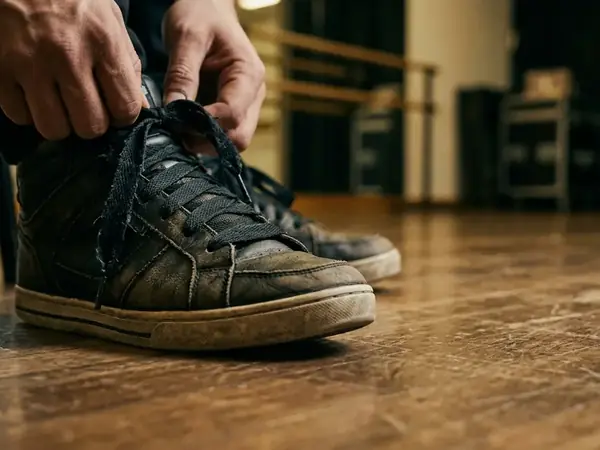
The physical challenge of shifting from an upward, lifted ballet posture to a grounded, plié-heavy hip-hop stance requires a complete rewiring of muscle memory. Ballet demands an illusion of weightlessness. The dancer must constantly fight gravity, pulling up through the spine and presenting a lengthened silhouette. Hip-hop demands an active relationship with the floor, a deliberate sinking into the joints that generates power from the ground up. Observation of Sara's preparation before steps reveals this biomechanical shift in stark detail.
The meaning of a lifted chest changes by context. In the final audition, it preserves a classical line. During the early club scenes, the exact same placement reads as guarded because the knees, pelvis, and shoulders fail to participate in the groove.
Across short phrases of four to eight counts, the early version of the character repeatedly organizes from the sternum upward. She returns to a narrow, nearly parallel base after each step. Later phrases hold the feet farther apart for two to four counts so that the hips can shift without the torso rising.
Biomechanical Adaptation Markers
The revealing interval is the fraction of a beat before locomotion. Early on, the head and chest announce the direction before the pelvis follows. In the rehearsal material, the knees soften first and the torso arrives roughly one accent later. This sequence visually represents the internal struggle of muscle memory yielding to a new physical vocabulary.
Rhythmic Syncopation: Transitioning from the Count to the Pocket
A deep plié by itself fails to demonstrate hip-hop musicality. Sara can lower her center while still placing every action squarely on the downbeat, leaving the phrase looking counted rather than pocketed. The transition from dancing strictly on the downbeat to finding the syncopated pocket of the music requires separating arrival time from accent time. This represents a profound cognitive leap for a classically trained dancer. Ballet often treats the music as a structural grid. Street dance treats the music as a conversation, requiring the dancer to live inside the spaces between the notes.
In the less comfortable phrases, one action tends to occupy each numbered beat of an eight-count. She completes a step directly on the strong beat and treats the next beat as a fresh instruction. The more settled passages layer a head accent, weight change, and foot placement across the spaces between counts two and three or six and seven. Subtle adjustments in head nods and footwork timing indicate a fundamental shift in musicality.
Isolating The Groove
A practical viewing test isolates this shift. Watch sixteen counts with the sound muted and then replay them with sound. Early movement exposes nearly every numbered count. Later movement contains rebounds and holds lasting roughly half a beat. This exposes the pedagogical limits of counting beats versus feeling the underlying groove.
Partnering Dynamics: Classical Framing Versus Cypher Momentum
Classical presentation directs the chest and face toward an imagined audience even when a partner supplies support. The classical frame favors matched facing lines and sustained contact through a hand, forearm, or supported torso. This creates a picture of unified geometry. Street-dance exchanges operate on a completely different spatial logic. They commonly break contact within one to three counts and preserve connection through mirrored direction or an answered accent. The connection becomes energetic and rhythmic.
The rehearsal montages highlight this transfer of weight and momentum. Sara's usable field of attention expands from a forward stage corridor to side and rear checks made within a single eight-count. This spatial awareness shifts dramatically when surrounding dancers form an arc instead of a straight audience line.
Spatial Awareness Shift
Where choreographic breakdown reveals spatial orientation habits, the finding follows: classical training locks the gaze forward, while cypher participation demands continuous peripheral scanning. The movement vocabulary adapts to a 360-degree cypher focus, contrasting the rigid, presentational framing of a classical pas de deux with the fluid, call-and-response nature of street dance.
The Synthesis of Form: Micro-Movements in the Final Audition
The climax of the film presents a technical merging of two distinct disciplines. True synthesis occurs only where both techniques affect the same phrase. The film avoids simply placing a ballet passage beside a hip-hop passage, opting instead for a complex physical dialogue. Specific micro-movements in the feet highlight this integration, transitioning rapidly from pointe work to flat-footed stomps. The sheer mechanical difficulty of this transition requires immense control.
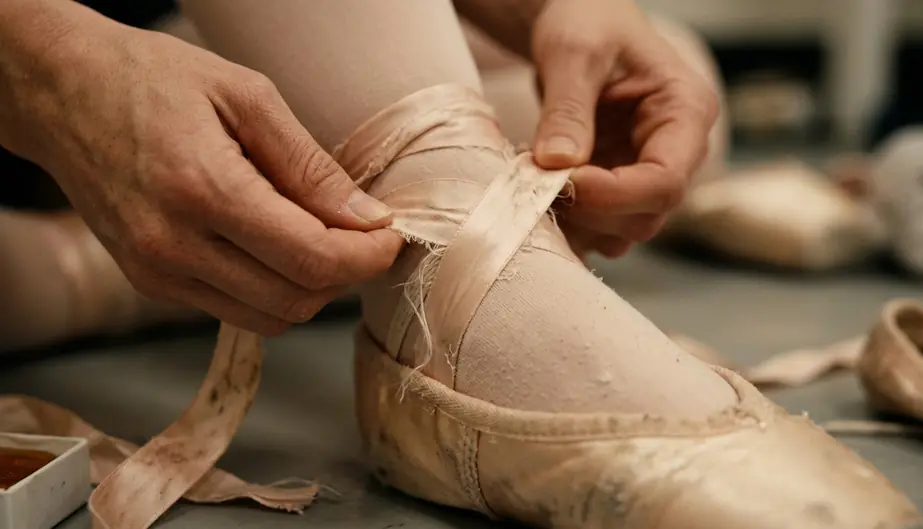
The footwear and support change requires a visible sequence of toe pressure, heel descent, knee flexion, and full-foot loading. The film compresses that adjustment into roughly two to four counts at several transition points. Shot length, reaction inserts, and the possible use of performance doubles prevent the finished film from proving that every transition was executed as one continuous phrase. Upper-body contrasts often occur inside one eight-count. An arm pathway remains extended for three to four counts, while the sternum or ribs insert one or two brief directional accents before the arm resolves. This integration of rigid upper-body port de bras with isolated torso isolations creates a highly specific movement signature.
Evaluating the Choreographic Legacy
The legacy of this movement vocabulary heavily influenced teen dance cinema released after 2001. The novice's progress is consistently shown through posture, groove, and social spacing. Romance doubles as private technical instruction. The most visible period of repetition runs from 2001 through the mid-2000s—an era when youth-oriented dance stories repeatedly paired institutional training with club, crew, or neighborhood movement settings. This formula provided a reliable narrative engine for filmmakers.
The film establishes Sara's change across three distinct movement contexts: public club dancing, one-to-one rehearsal, and the final institutional audition. The audience sees social discomfort, technical correction, and performance payoff. Tracking genre trends across the early 2000s release windows, this tripartite structure became the blueprint for a decade of dance cinema.
Does a compressed cinematic portrayal of technical mastery honor the grueling reality of cross-training, or does it permanently distort public expectations of how quickly a dancer can conquer an entirely alien physical vocabulary?