Table of Contents
- A Fifteen-Second Clip Can Rewrite Who Made the Music
- Film Mix, Retail Album, Streaming Playlist: Three Separate Objects
- Rehearsal Room, STEPPs, and the Juilliard Audition Under Close Listening
- Confirming a Cue Was Really in the 2001 Cut
- Trailers, Music Videos, and Two Rival Companies Behind One Movie
A Fifteen-Second Clip Can Rewrite Who Made the Music
Swap the song under Sara and Derek's dancing and you change who gets credit for the scene. That is the whole problem, and it is bigger than it sounds.
Every week I watch reposted clips of Save the Last Dance circulate with a different early-2000s R&B track laid over them. Sara Johnson (Julia Stiles) and Derek Reynolds (Sean Patrick Thomas) move through the studio or across the floor at STEPPs, and underneath them plays a song that sounds exactly like 2001. The period texture is right: the swung hi-hats, the glossy vocal stacks, the bass sitting low and round. The record itself never touched the theatrical reel. A few hundred comments later, viewers accept it as the original cue.
I call this synthetic nostalgia. It works because the substitute is plausible. Nobody pairs Julia Stiles with a 2019 trap beat and fools anyone, but a song from the same radio year slides into memory with almost no friction.
From an archival standpoint, the evidence hierarchy has to be set before anything else. A social-video soundtrack documents the edit. The corresponding passage in the released film documents the film cue. Those are two different historical records, and only one of them tells you what audiences heard in theaters in January 2001.
When I log a suspicious clip, I record four things before drawing any conclusion: the account name, the caption, the displayed audio attribution, and the matching scene location in the film. I also keep three attribution fields strictly separate: recording artist, choreographer, and on-screen performer. Replacing a recording does nothing to the dancers' work or the choreography's authorship, yet viral edits quietly blur all three into one impression.
Repost Audio Isn't Provenance
The audio label a platform displays reflects what the uploader attached. Treat it as a claim about the edit, never as a claim about the 2001 film.
Film Mix, Retail Album, Streaming Playlist: Three Separate Objects
Before comparing a single song title, I separate the evidence into three objects. Skipping this step is how an album listing turns into an unsupported scene attribution.
The theatrical audio
The first object is the film itself: a fixed audiovisual release from 2001, mixed for the Paramount Pictures theatrical distribution. Dialogue, score, licensed songs and effects are locked together. Whatever plays under a given frame in that edition is the historical fact.
The commercial compilation
The second object is the retail soundtrack album issued by Hollywood Records the same year. It is a separately sequenced music product with its own running order, its own mastering and its own commercial goals. Era albums frequently carried radio-ready singles from a label's roster, some of which surfaced for a moment in the background of a scene and some of which never appeared in the film at all. That was a common industry model, and some packaging said so openly with phrases like "music from and inspired by." Whether this particular album uses that wording is something to transcribe from the physical packaging, not assume.
The practical rule follows directly. A track's presence on the album establishes album inclusion. Calling it an album-only promotional cut requires a separate check of the film.
Version matters too. I compare entries on song title, credited performer and recording version, because a remix, a clean edit and an album version can share a title while sounding audibly different on screen.
The modern playlist layer
The third object is the newest and the most slippery: user-generated playlists on streaming services that merge the official tracklist with unrelated 1999 to 2002 hits, mostly to capture nostalgic search traffic. These playlists can change after publication, which makes them poor evidence for anything.
Their cover art compounds the problem. A playlist wrapped in a still of Sara and Derek borrows the film's authority visually, but their faces on the thumbnail do not carry that playlist's songs backward into the 2001 theatrical mix.
One rights distinction belongs here because fans often get it tangled. Synchronization permission concerns the musical composition paired with moving images; master-use permission concerns the specific sound recording. The U.S. Copyright Office circular on music licensing lays out how compositions and sound recordings are treated as separate works, which is why a film can feature a song in one recording while the album carries another.
Rehearsal Room, STEPPs, and the Juilliard Audition Under Close Listening
I organize any audit of this film around three dance settings rather than around a remembered playlist: Sara and Derek's rehearsal sessions, a dance passage at STEPPs, and Sara's final audition. For each, I note the source edition and the cue's first and last audible moments. Only then does the retail album enter the comparison.
Take "You Can Do It" by Ice Cube featuring Mack 10 and Ms. Toi. It is a recording many people associate with the film, and it appears on the soundtrack album, which makes it a useful test case. I treat it exactly like any other candidate: its scene placement has to be established from the film before I would publish a timestamp or say anything about the choreography it accompanies. Association, however strong, is not placement.
The opposite error deserves equal suspicion. I do not designate any named song an album-only cut until its alleged absence has been checked against the film. A retail tracklist cannot prove a negative.
Mark Isham's score as the connective tissue
Licensed hip-hop and R&B get the attention, but Mark Isham composed the film's original score, and that score carries a structural job: it bridges the classical ballet world Sara comes from and the hip-hop world she enters with Derek. Pop compilations of the era rarely gave score much room, so this layer is easy to forget when people reconstruct the film from an album. I keep Isham's composer credit in its own column, distinct from the performer credits attached to licensed songs.
How replacement memory takes hold
The audition and the club sequences are the most frequently re-scored moments online. An edit swaps the theatrical audio for a different early-2000s hit, the movement still reads as energetic, and thousands of commenters accept the swap as original.
The fix is unglamorous. Compare the same visible movement in both sources: a landing, a head accent, a sharp change of direction. Matching a discrete event is far easier than matching a general impression of rhythm.
Confirming a Cue Was Really in the 2001 Cut
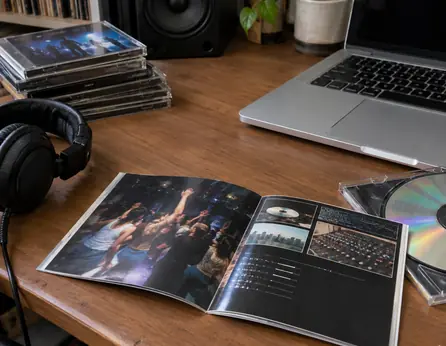
This is the procedure I run. It is slow on purpose, and every claim it produces carries a source locator: booklet page or panel, end-credit timestamp, and scene timestamp, all tied to the same identified edition.
- Read the physical packaging. Inspect the booklet, tray card and disc of the 2001 Hollywood Records release, or scans tied to an identifiable pressing. Transcribe producer and performer credits exactly as printed. Remembered wording drifts; ink does not.
- Check the end titles against the scene. Find the song's entry in the film's closing credits and compare it with what you actually hear in the relevant passage. The crawl is important primary evidence about the licensed music in the cut, though I would not treat it as a universally mandated or automatically exhaustive record. Pair it with the audio itself.
- Run a movement check on the viral clip. Pick an eight-bar passage and compare at least three visible accents near its beginning, middle and end against the soundtrack under them. This is an inspection procedure, not a measurement of the film's choreography.
Step three has a real limit, and it applies specifically to dance footage: a replacement track edited to the same tempo can stay locked to the dancers for the whole clip. A convincing beat match proves nothing on its own. A direct comparison of recording identity against the film is the stronger evidence every time.
Dates mislead as well. A streaming release date may reflect a reissue or digital delivery rather than first commercial release, so I record the displayed date without treating it as proof of original publication.
One Edition, Every Timestamp
This audit covers the 2001 theatrical release only, not the 2006 sequel or broadcast versions. Mixing editions mid-check invalidates the comparison.
Trailers, Music Videos, and Two Rival Companies Behind One Movie
Part of the confusion was engineered. Cross-promotion in 2001 deliberately attached songs to film imagery through trailers and music video rotation, so a track could feel inseparable from the movie without ever playing inside the story.
I distinguish three placements in the promotional record: a narrative scene, the end titles, and an external trailer or music video. A song can occupy one without occupying the others. Film clips or cast members appearing in a video establish a marketing connection, and nothing more; any claim about a specific video needs the video itself and a documented promotional link.
Two decades on, audiences remember the campaign as if it were the film. That is understandable, and correctable.
The stakes are concrete. Accurate history keeps the recording artist's credit attached to the scene they scored, keeps the choreographers' authorship intact, and keeps Stiles and Thomas credited for performances built to specific music. When I write up any scene, I preserve the original performer credit beside the description instead of crediting whoever accompanies the latest repost.
Credit Follows the Reel
Album, trailer and playlist are marketing records. The theatrical audio is the only record of what played under the dancing.
And the corporate structure explains why the album never needed to mirror the film. The soundtrack came out on Hollywood Records, a label owned by Disney, while the movie itself was released through rival studio Paramount Pictures: two competing entertainment groups, two separate commercial channels, one title on the cover.