Twenty-Four Days Between the Jewel Case and the Theater
The soundtrack reached stores on December 19, 2000. The film reached screens on January 12, 2001. Twenty-four days separate those two events, and that gap is the most useful analytical object in the entire project. For just under a month, the album had to sell a story that nobody had watched yet. Every sequencing decision, every licensed hook, every fade had to carry narrative weight in the absence of images.
So here is the question I keep circling back to: how much of a film's sonic identity can survive compression into one commercial disc?
Not much, structurally speaking. A retail album in 2000 answered to running time, licensing budgets, radio singles, and label rosters. A dance film answers to counts, breath, floor contact, and the physical difference between a jump landing on the beat and a jump landing a sixteenth behind it. Those two sets of constraints overlap, and the overlap is what got pressed. The remainder—the tracks that would have played over a rehearsal, a bus ride, a corner cypher—stayed off the manifest.
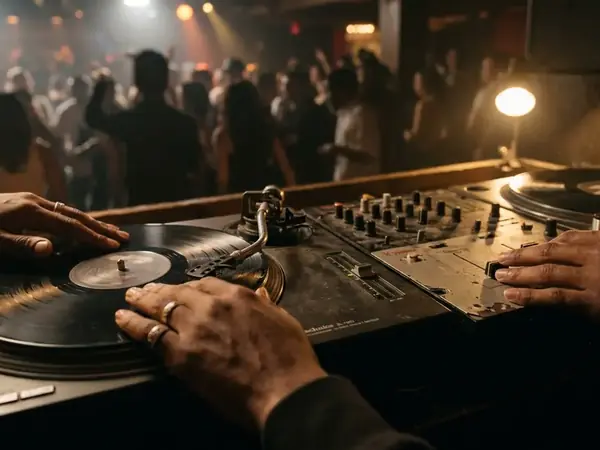
Late 2000 through early 2001 is the correct listening window for reconstructing that remainder. In those months, layered R&B vocals, clipped snares, sampled soul, and low-frequency rap production were all audible in the same youth spaces at the same time. Chicago-rooted R&B and rap were not a regional footnote in that mix; they were part of a crossover already fully underway in clubs, and that crossover is documented across a long historical evolution of urban dance music. The film's premise—a ballet-trained body learning a vocabulary built on displaced accents—works because the score sat exactly on that seam.
Three Passes Before a Track Earns a Scene
I screen every candidate three times, in a fixed order, and a track that fails an earlier pass never reaches the next one.
Pass one is chronological. The original release date must fall between January 1, 1999 and December 31, 2001. That is a 36-month window, and it is deliberately narrow. A record from 2003 might sound period-adjacent to a casual listener, but its production grammar belongs to a different room.
Pass two is sonic. The track must carry at least two elements already compatible with the film's palette: an assertive bassline, displaced or syncopated snare hits, close-stacked R&B harmonies, or a loop stable enough to survive repeated eight-counts without fatiguing the ear.
Pass three is functional. Instead of ranking tracks against each other, I assign each one a scene job. Club selections need 16 to 32 bars of uninterrupted drive. Rehearsal selections need a legible eight-count that a solo dancer can hear over their own footfalls. Romantic selections need enough midrange space left open for dialogue, breath, and the sound of a shoe pivoting on hardwood.
The boundary I hold to is geographic as much as temporal: the Midwest club and R&B listening environment surrounding the release window. Post-2001 crunk and snap records are excluded even when their tempos would suit the choreography beautifully. That exclusion costs the list some obvious floor-fillers, and I accept the cost.
Window Discipline
Tempo compatibility is not eligibility. A 2003 record at 95 BPM will lock to the same eight-count as a 2000 record at 95 BPM, and it will still misrepresent what a Chicago club actually sounded like the month this film opened.
Building the Club Sequence in Three Steps of Texture
The club material should escalate, and escalation here means texture rather than volume. Each of these three does a different job in the rise.
1. "X" — Xzibit (2000)
Use the first 16 to 24 bars as an entrance. The brass-like stabs and Dr. Dre-produced low end arrive with no negotiation, and I cut those accents to shoulder hits and hard direction changes. Tempo references generally place the record in the roughly 98–102 BPM range, which reads slow on paper and fast on the floor once you treat it in double-time for steppin' footwork.
2. "U Already Know" — Do or Die (2000)
From the Chicago group's Victory album, and the most locally specific choice on the list. Reserve a 16-bar passage for heel-toe steps, torso rebounds, and rapid hand accents that track the compressed vocal phrasing. The rapid syllabic flow gives a dancer more rhythmic information per bar than almost anything else in the window, which is exactly what a crowded floor sequence needs.
3. "Where the Party At" — Jagged Edge (2001)
The release-window latecomer, and the texture change that resolves the first two. Its roughly mid-90s BPM groove supports two eight-counts of battle choreography followed by two eight-counts of partner-facing movement. The vocal stack softens the room without dropping the drive.
Lowering the Volume Without Losing the Count
The rehearsal studio demands the opposite of the club: less density, more legibility.
4. "Try Again" — Aaliyah (2000)
Timbaland's production isolates kick, snare, bass, and a few small electronic details instead of filling every beat, and the empty space is the point. The groove sits near 93 BPM, which lets a dancer drill a four-eight-count phrase for 90 to 120 seconds before stopping to correct. Repeat that phrase and you hear precisely where a landing arrives early or a shoulder accent drifts late.
5. "The Light" — Common (2000)
The Chicago rapper's sample-led loop is the romantic and fusion selection. Stage a 32-count ballet-fusion passage across it: the first 16 counts for controlled extensions, the second 16 for lower, weighted transitions into the floor. The midrange stays open, so breath and shoe contact remain part of the texture rather than casualties of it.
Rehearsal Playback Levels
Start at conversational volume while marking. Raise the bass only for two or three full-out repetitions, then bring it back down. If foot contact and breathing disappear under the low end, corrections stop being possible.
Chalk Dust, a Silver Boombox, and One Full-Out Repetition
The formal rehearsal ended forty minutes ago. The studio is empty, the floor scuffed pale in the traffic lanes, chalk dust still hanging near the barre where somebody powdered their hands and never swept up.
She lowers the handle on a silver portable boombox, presses the CD play button, and waits through the brief mechanical spin. Twenty, maybe thirty seconds cover the whole thing: the tray click, the disc catching, the opening beat.
First eight-count, she marks it — arms half-height, feet indicating rather than committing. Second eight-count, she takes it full out. At the first bass accent the cabinet buzzes against the hardwood, and a pair of worn ballet slippers hits the floor: one controlled landing, then a grounded rebound that has nothing classical about it at all.