Table of Contents
- The Greyed-Out Club Cue Before a Studio Warm-Up
- Reading a Used Hollywood Records Disc Like an Archivist
- Downloads, Streams and the Lucy Pearl Test
- Advisory Badges, Muted Syllables and the Workshop Playlist
- Telling the 2001 Album Apart from the 2006 Sequel and Its Imitators
The Greyed-Out Club Cue Before a Studio Warm-Up
You are lacing up ten minutes before a warm-up, phone propped against the mirror, and you scroll the album looking for the cut that carried you through the Chicago club scenes in the film. The title is there, but it sits in pale grey type. Tap it and nothing happens. The track after it plays fine, which somehow makes the gap worse.
That small frustration is worth turning into an audit, because it hides three different questions inside one. The recording you remember from a scene, the slot it occupies (or doesn't) on the commercial album, and the playable entry on a streaming service are separate things. Keeping those three apart helps explain why a song can seem to be missing.
Start with the first distinction. The original 2001 soundtrack compilation has 14 tracks, and it was never a complete collection of every recording heard in the film. Some songs you associate with a scene may simply never have been licensed for the album. Others are on the album but have drifted out of a given digital catalog.
Early-2000s studio compilations were assembled from recordings owned by many different labels, each licensed for a particular product. Two decades on, those agreements fragment unevenly across services. Digital availability is specific to the service, territory, account and date you check, so log all four alongside any screenshot of a greyed-out title before you conclude a song is gone.
Check both the album page and the individual track page, too. A search result can quietly route you to a different release that happens to carry the same song. Once you know which of the three things you are actually missing, choosing between a used CD, a download and a stream becomes a practical comparison instead of guesswork.
Reading a Used Hollywood Records Disc Like an Archivist
The physical CD earns its place as the reference copy for one reason: it fixes the sequence. Fourteen positions, in order, printed on the rear insert and burned into the disc. Treat it as the anchor for the compilation's identity. It makes no automatic claim to superior sound or an exclusive mastering, and it doesn't need one to be useful.
What to Ask a Seller For
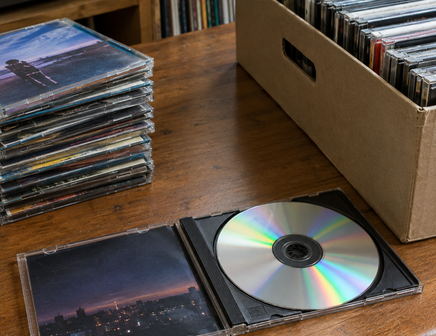
Online listings tend to show the front cover and little else. Request three photographs before paying:
- The rear insert, so you can account for all 14 track positions.
- The disc face, label side up.
- The inner ring of the playing surface, angled so the stamped markings are readable.
Compare the catalog identifier across the spine, the insert and the disc itself. They should agree. Then record the complete matrix string from the inner ring, suffixes included, and compare it with a documented release entry. Copying only the catalog number from the spine tells you very little, since that number travels across several manufacturing runs.
A record-club marking deserves careful handling. Treat it as an edition identifier and note it as such; it tells you which manufacturing path the disc took, which matters if you are cataloguing editions and matters less if you only want the 14 songs in order.
Under angled light, inspect the playing surface for scratches that follow the circular track path. Those are the ones most likely to cause read errors, because they run along the data spiral rather than across it.
From Shelf to Pocket
Ripping the disc bridges ownership and portability. An audio CD rip normally retains its native 16-bit, 44.1 kHz audio in FLAC or ALAC. Upsampling to a higher rate adds no recovered musical detail; the information was never on the disc. After extraction, count the files against the rear insert one more time. Fourteen in, fourteen out.
Spine Codes Can Lie
A matching spine is the easiest thing for a mismatched case to fake. Discs get swapped between cases constantly in secondhand bins, so the matrix string on the disc outranks anything printed on paper.
Downloads, Streams and the Lucy Pearl Test
Audit a download purchase and a subscription stream as two separate products, because they fail in different ways.
Auditing a Permanent Download
- Confirm every album track is purchasable, position by position.
- Identify the file format the store actually supplies.
- Confirm the files can be saved locally and played without the store's app.
Auditing a Streaming Edition
- Inspect each track's availability individually.
- Follow each track's metadata to the release page it links back to.
- Build a log with track title, credited performers, displayed duration, source release and explicit-content flag for each of the 14 positions.
The source-release column is where substitutions show up. Use three songs as named test cases: Lucy Pearl's 'You,' Donell Jones's 'U Know What's Up' and K-Ci & JoJo's 'Crazy.' If any of them links back to a hits collection or an artist album instead of the soundtrack release, you may be hearing a different master or a re-recording.
Duration helps, but only to a point. Check it to the displayed second, then listen. Compare the opening 10 to 15 seconds and the final 10 to 15 seconds of a suspect track against a reference copy, and play through a recognizable verse or chorus transition. Differences in vocals, edits and fades identify a version. Matching length on its own proves very little.
When a streaming edition greys out individual hip-hop collaborations, a hybrid local-file playlist fills the holes: ripped or purchased files for the missing positions, streamed entries for the rest, ordered to the original sequence. Test it with the device disconnected from the network before taking it into a dance studio. A playlist that silently skips offline is worse than no playlist at all.
Advisory Badges, Muted Syllables and the Workshop Playlist
Retail in this period often handled explicit content through separate edited pressings for stores that would not stock advisory-labelled product. Whether this soundtrack existed in two such versions is something to verify from release evidence on the item in your hand, rather than assume because the practice was common. The RIAA's Parental Advisory label guidelines explain what the badge is meant to signal.
Start with the packaging: the advisory badge, any edition wording such as "edited" on the cover or spine, and the track-level explicit tags in your digital log. Then audition.
Ice Cube's 'You Can Do It' and Snoop Dogg's contribution to Lucy Pearl's 'You' make the best starting points. Take the same lyric passage in each candidate edition and listen for silence, reversed syllables, replacement words or a removed phrase. Any reference you find to Xzibit should be checked against the actual printed tracklist and credits before you go hunting for his verse.
Runtime is a trap here. An edited word can occupy exactly the same duration as the original, so two files that match to the second can still carry different lyrics.
For a youth choreography workshop, audition every selected song in full, including guest verses, introductions and outros, since a clean chorus says nothing about a guest verse two minutes in. Save the approved tracks in their own local playlist and switch off automatic continuation into recommended songs. At home, the unabridged edition is the one that matches the album as released, and that is usually what a collector wants.
Before the Kids Arrive
Autoplay is the real risk in a classroom. A perfectly vetted playlist can roll straight into an unvetted recommendation the moment the last track ends.
Telling the 2001 Album Apart from the 2006 Sequel and Its Imitators
The film arrived in 2001. Its direct-to-video follow-up, 'Save the Last Dance 2,' followed in 2006, with its own soundtrack. Listings blur the two constantly, and third-party tribute albums borrow the title for search traffic.
Establish release identity before looking at artwork. Match the subtitle, the year, the performer credits and the back-cover sequence. The original compilation opens with 'Shining Through (Theme from Save the Last Dance)' by Fredro Starr featuring Jill Scott, and that first slot is a fast filter. It is only a filter, though. Track one establishes the album's opening identity, and the remaining 13 positions establish whether the purchase actually matches it. One correct title authenticates nothing on its own.
Then turn to the fine print. Inspect the phonogram copyright line and the printed production credits against an authenticated scan of the original, and separate the recording copyright year from any later reissue or packaging date. Producer credits should come from the back cover or booklet itself. A seller's abbreviated listing is a poor substitute for the printed credit.
Fourteen Before Buying
- Confirm the 2001 film soundtrack, rather than the 2006 sequel or a tribute recording.
- Compare the complete 14-track sequence with a photographed original back cover.
- For a used CD, obtain disc-face, spine and inner-ring photographs and record the full matrix string.
- For digital copies, log source release, duration and explicit flag for every position.
- Audition edited passages; never rely on runtime alone.
The disc in your hand has a matrix that matches its entry, an insert with all fourteen positions, and a copyright line that reads the right year. You slide it into the home deck, or tap play on the FLAC folder you ripped and checked offline last week. The first synth figure opens up, strings swell beneath it, and Fredro Starr comes in ahead of Jill Scott's voice. Then the second track follows, then the third, straight through the club cuts that were greyed out on your phone, without a single skipped beat.